
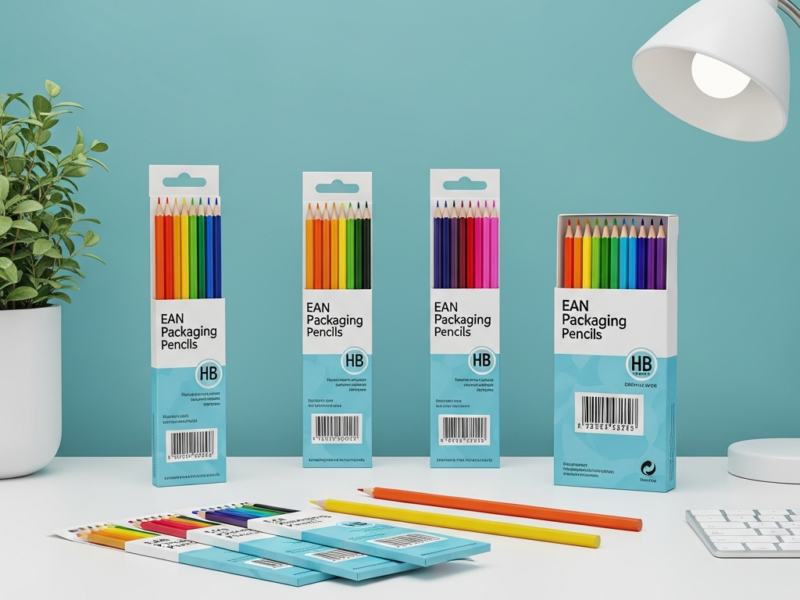
The transition from a boutique stationery workshop to a high-volume retail supplier is a journey defined by standardization, and perhaps no element is more critical to this evolution than the implementation of global identification systems. For manufacturers and brand owners, mastering the nuances of barcode packaging pencils is not merely a technical hurdle but a strategic gateway to entering international markets and securing placement on the shelves of major retailers. This article explores the intricate world of EAN barcodes within the pencil industry, detailing why these 13-digit identifiers are the lifeblood of modern supply chains, inventory management, and consumer satisfaction. By understanding the intersection of manufacturing precision and digital tracking, stationery professionals can ensure their products move seamlessly from the production line to the artist’s hand.
The Fundamental Role of EAN Barcodes in Stationery Retail
In the global marketplace, the European Article Number (EAN), specifically the EAN-13 variant, serves as the universal language for product identification. While many American manufacturers are familiar with the 12-digit UPC code, the EAN-13 is the predominant standard used across Europe and much of the international community, acting as a unique fingerprint for every product. For those involved in the production and distribution of barcode packaging pencils, this standard ensures that a specific set of HB graphite pencils is distinguishable from a set of watercolor pencils, even if they share similar external packaging. This uniqueness is what allows global retailers to manage thousands of Stock Keeping Units (SKUs) simultaneously without the risk of data overlap or inventory errors. According to industry experts, the EAN code is foundational to international commerce, providing the necessary infrastructure for products to cross borders and enter diverse retail ecosystems without requiring relabeling at every stop. For further reading on the structural differences between these codes, you can visit this guide on UPC and EAN barcodes. The EAN-13 code consists of a GS1 prefix, a manufacturer code, a product reference, and a check digit, creating a robust system that minimizes the possibility of scanning errors at the point of sale.
Enhancing Supply Chain Efficiency Through Digital Tracking
The strategic utility of barcode packaging pencils extends far beyond the checkout counter, serving as a critical tool for end-to-end supply chain visibility. In the context of manufacturing, a barcode allows for the real-time tracking of raw materials, work-in-progress components, and finished goods as they move through the factory and into the warehouse. This level of precision is vital for large-scale operations where even a minor discrepancy in stock levels can lead to significant financial losses or missed delivery deadlines. By integrating EAN barcodes into a comprehensive database, businesses can achieve a level of operational robustness that was previously impossible. This integration enables automated stock replenishment, where a retailer’s system automatically triggers a reorder once the pencil inventory hits a certain threshold, ensuring that shelves are never empty. This proactive approach to logistics is a core enabler of competitive advantage in the fast-paced stationery market. As highlighted by logistical specialists, the detailed information linked via these codes is essential for maintaining streamlined operations and reducing human error. To learn more about how these standards impact logistics, refer to this resource on barcode supply chains. When a master carton of pencils is scanned at a distribution center, the system immediately knows the quantity, batch number, and destination, facilitating a friction-less flow of goods.
Practical Benefits for Retailers and Inventory Management
For a retailer, the presence of a clear, scannable EAN-13 barcode on a pencil box or an individual barrel is non-negotiable. Modern retail environments thrive on speed and data accuracy; a product that requires manual entry at the register is a product that costs the retailer time and money. When implementing barcode packaging pencils, brands provide retailers with an invaluable data capture tool that fuels sales analytics and stock replenishment strategies. Every scan provides a data point that helps the retailer understand consumer behavior, seasonal trends, and product performance. This information allows store managers to make data-driven decisions about shelf placement and promotional activities, ultimately improving the bottom line. Furthermore, the use of EAN-13 codes accelerates the checkout process, enhancing the customer experience by reducing wait times. In the high-volume world of office supplies and back-to-school shopping, this efficiency is the cornerstone of operational success. Expert analysis from World Barcodes emphasizes that the availability of product information through a simple scan is the bedrock of modern retail efficiency. By adhering to these standards, pencil manufacturers ensure their products are “retail-ready,” which significantly lowers the barrier to entry for new distribution partnerships.
The Manufacturing Perspective: Printing and Placement
Integrating barcodes into the physical design of pencils and their packaging presents unique manufacturing challenges that require specialized knowledge. Unlike flat surfaces, the curved barrel of a pencil requires precise printing techniques to ensure that the barcode remains readable by scanners. When designing barcode packaging pencils, engineers must consider the “ladder” vs. “picket fence” orientation. On a cylindrical object, a barcode oriented like a ladder (with bars perpendicular to the axis of the pencil) often scans better than one oriented like a picket fence. Furthermore, the material of the pencil—be it traditional cedar, plastic-based composites, or lacquered finishes—affects the ink’s adhesion and the contrast ratio between the bars and spaces. In the packaging phase, whether it is a cardboard tuck box, a tin, or a blister pack, the barcode must be placed in a “quiet zone” free from other graphics or text that could interfere with the scanner’s laser. High-quality UV-cured inks are often used in stationery manufacturing to prevent the barcode from smudging during transit, ensuring that the code remains pristine from the factory to the retail shelf. Manufacturers also utilize verification systems on the production line to check the “grade” of each barcode, ensuring that only those with high readability reach the market.
| Feature | EAN-13 Standard | UPC-A Standard |
|---|---|---|
| Digit Count | 13 Digits | 12 Digits |
| Primary Region | Global (Europe, Asia, Oceania) | North America (USA & Canada) |
| Standard Body | GS1 Global | GS1 US / GS1 Global |
| Scanning Compatibility | Universally Scannable | Mostly Universally Scannable |
| Manufacturer Code | Variable Length | 6-9 Digits |
Adhering to GS1 Global Standards
To ensure that barcode packaging pencils are recognized by every retail system worldwide, it is imperative to source barcode numbers from GS1, the official global standards organization. Using “resold” or “placeholder” barcodes can lead to significant issues, including products being rejected by major retailers like Amazon, Walmart, or Carrefour, who require authentic GS1-registered prefixes. GS1 barcodes are the most extensively used product identifiers in history, providing a level of credibility and interoperability that is essential for global trade. By registering with GS1, a pencil manufacturer gains a unique company prefix that serves as the foundation for all their product codes. This registration ensures that your product’s data is logged in the Global Electronic Party Information Registry (GEPIR), allowing retailers to verify the brand’s identity instantly. This transparency is vital for preventing counterfeit goods and ensuring that the supply chain remains secure. As the ultimate authority in the field, GS1 provides the framework that allows even the smallest pencil manufacturer to compete on a global stage. For the official perspective on these standards, businesses should consult the GS1 standards page, which details the technical requirements for barcode implementation across all consumer categories.
Debunking the Myth: Barcodes for Small Stationery Brands
A common misconception among artisanal pencil makers and small stationery brands is that sophisticated barcode systems are reserved for large corporations with massive budgets. However, the reality is that barcode packaging pencils offer significant benefits to businesses of all scales, from local gift shops to emerging online brands. For a small business, barcodes facilitate professional inventory control, reducing the likelihood of “out-of-stock” scenarios that can frustrate customers. They also enable faster checkout processes at craft fairs or in-store pop-ups, allowing the business owner to focus on customer engagement rather than manual price entry. The democratization of barcode technology means that even a small-scale producer can implement a basic scanning system using a smartphone and affordable software. This investment leads to reduced errors and operational cost savings that can be reinvested into product development or marketing. As noted by the experts at TEKLYNX, barcodes are an accessible tool for organizational efficiency that helps small enterprises scale effectively. By adopting professional standards early on, small brands position themselves for future growth, making it much easier to transition into larger retail environments when the opportunity arises.
Technical Specifications and Design Considerations
When preparing the artwork for barcode packaging pencils, graphic designers must adhere to strict technical specifications to ensure scannability. The standard size for an EAN-13 barcode is 37.29mm wide by 25.93mm high, although it can be scaled down to 80% or up to 200% depending on the packaging size. Reducing the height of the barcode (truncation) is common in the pencil industry due to the slim nature of the products, but it should be done sparingly as it can make scanning more difficult for omnidirectional scanners. Color choice is another critical factor; the bars must always be a dark color (ideally black, dark blue, or dark green) on a light, non-reflective background (white or pale yellow). Red is generally avoided for barcode bars because many scanners use a red light source, which would make the bars “invisible” to the reader. Additionally, designers must maintain a “Quiet Zone” on both the left and right sides of the barcode. These are blank spaces that signal to the scanner where the barcode begins and ends. Failure to respect these zones is one of the most common reasons for barcode failure in the stationery sector. In high-end pencil manufacturing, the barcode is often integrated into the sleeve or the back of a tin, ensuring it doesn’t detract from the aesthetic appeal of the branding while remaining fully functional for logistics.
Pros and Cons of Different Barcode Application Methods
Choosing the right method to apply barcode packaging pencils depends on the production volume and the packaging material. Manufacturers generally choose between direct printing, adhesive labeling, or pre-printed packaging. Each method has its own set of advantages and drawbacks that impact the final cost and retail appearance.
- Direct-to-Product Printing: This involves printing the EAN code directly onto the pencil barrel using pad printing or screen printing. Pros: Permanent, professional appearance, no extra materials. Cons: High setup cost, difficult on thin or textured surfaces.
- Adhesive Labels: Applying a separate sticker with the barcode onto the pencil or its box. Pros: Flexible, low initial cost, easy to update. Cons: Can peel off, looks less “premium,” labor-intensive for high volumes.
- Pre-Printed Packaging: Incorporating the barcode into the design of the cardboard box or tin during the offset printing process. Pros: Lowest cost per unit at high volumes, perfect integration with branding. Cons: Requires large print runs, cannot be changed once printed.
The Workflow of Barcode Implementation
Implementing a successful system for barcode packaging pencils requires a coordinated workflow between the manufacturer, the designer, and the logistics team. Following these steps ensures that the product is retail-ready from day one:
- Obtain a GS1 Company Prefix: Register your business with GS1 to receive a unique prefix that identifies your brand globally.
- Assign Unique GTINs: Assign a Global Trade Item Number (GTIN-13) to every unique pencil product, ensuring that different grades (HB, 2B, etc.) and pack sizes have their own numbers.
- Generate Barcode Images: Use high-resolution software to generate EAN-13 barcode images based on the assigned GTINs.
- Integrate into Packaging Artwork: Place the barcode in the design file, ensuring correct sizing, orientation, and quiet zones.
- Perform Print Tests and Verification: Print a sample and use a barcode verifier to ensure the code meets ISO/IEC standards for readability.
- Log Data in the Retailer Portal: Upload the GTIN and product specifications (weight, dimensions, description) to the retailer’s database or a global registry.
Future Trends in Stationery Barcoding
As we look toward the future, the technology behind barcode packaging pencils is evolving beyond the simple EAN-13. We are seeing the rise of 2D barcodes, such
Related Reading
- Boost Pencil Sales with Barcode Packaging Solutions
- Retail-Ready Pencil Packaging: Boost Retail Efficiency and Sustainability
- Packaging Compliance EN71 Guide for Pencil Manufacturers
- Multilingual Packaging OEM Strategies for Global Brands
- Why Stretch Film Pencil Packaging Dominates in Europe
- Accurate Print: Key to Consistent Branding with Pencils
- Pencil Export Logistics Strategies for Factory Efficiency
- Understanding the Global Pencil Supply Chain