
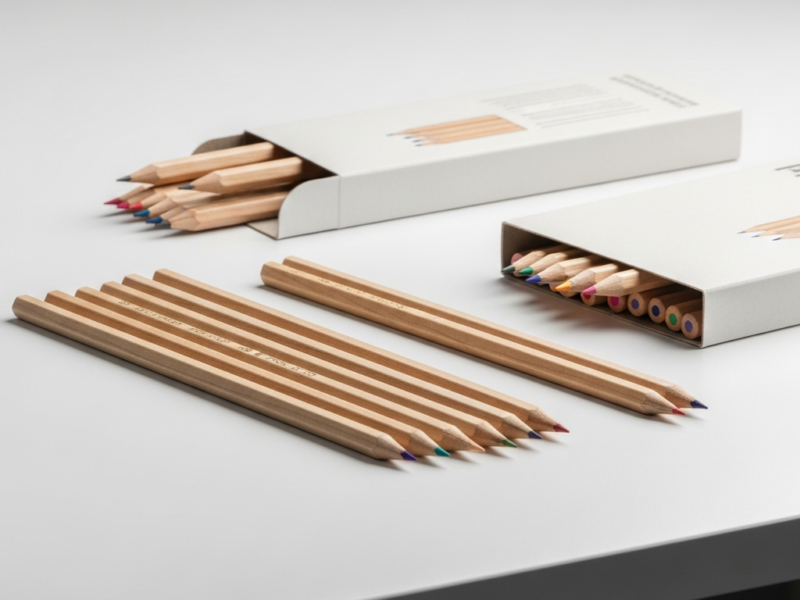
The pursuit of a perfectly sharp pencil point often focuses intensely on the sharpener itself—the quality of its blades, the angle it cuts, or whether it’s a hand-cranked workhorse or a simple manual model. Yet, a crucial, often overlooked, variable in achieving optimal sharpening precision lies not with the sharpener, but with the pencil’s very foundation: its barrel. The geometry of the pencil’s wooden casing, specifically its roundness and concentricity, plays an unexpectedly significant role in dictating the quality, consistency, and longevity of the sharpened graphite core. Without proper barrel integrity, even the finest sharpener struggles to deliver a truly uniform and durable point, fundamentally impacting the writing and drawing experience.
The Unseen Mechanics: How Barrel Shape Dictates Sharpening Dynamics
At its core, pencil sharpening is a process of controlled material removal. A sharpener’s blade abrades the wood and graphite, gradually forming a conical or parabolic point. For this abrasion to be even and symmetrical, the pencil must rotate with absolute stability within the sharpener’s cone. Here, the barrel’s geometry becomes paramount. A perfectly round pencil barrel ensures a consistent point of contact with the sharpener’s internal mechanism, allowing for smooth, wobble-free rotation. This stability translates directly to uniform material removal around the entire circumference of the pencil, preventing uneven grinding that can lead to lopsided points, weakened tips, and increased breakage.
Consider the manufacturing process: achieving a consistently round barrel requires meticulous wood selection and precise milling. High-quality pencils undergo stringent quality control, utilizing advanced measurement techniques like laser scanning or precision calipers to ensure minimal deviation from a perfect circle. An irregularly shaped barrel, even by microscopic margins, introduces eccentricity into the sharpening rotation. This wobble causes the blade to engage with the pencil unevenly, removing more material from one side than the other, resulting in an asymmetrical point. From an OEM manufacturing standpoint, the investment in machinery and processes to produce consistently round barrels is a critical differentiator, directly impacting the end-user’s experience of a “good” pencil that sharpens cleanly every time.
From Steel Edge to Graphite Point: The Burr’s Equivalent in Pencil Sharpening
To truly understand sharpening precision, we can draw parallels from the highly refined world of knife sharpening. In that domain, a key indicator of successful material removal and edge formation is the “burr”—a microscopic fold of steel that forms at the apex of the blade as metal is abraded from opposing sides. Experienced sharpeners detect this burr tactilely, often by gently drawing a finger or nail from the spine towards the edge, feeling for any resistance or “catch,” which signifies its presence. This technique, highlighted in community discussions like those on Reddit’s r/chefknives, indicates that enough material has been removed from one side to create a new, nascent edge.
While a pencil’s “burr” isn’t a metallic fold, the principle of a uniform indicator of material removal still applies. As a pencil sharpens, a fine lip of wood fibers and graphite dust often forms at the very tip of the point. This isn’t a flaw, but rather the pencil’s equivalent of a burr—a tactile and visual sign that the sharpener’s blade has effectively cut through the wood and graphite layers to meet at a precise apex. Just as a consistent burr along a knife edge signals uniform grinding, a symmetrical, fine “pencil burr” around the circumference of a pencil point indicates that material has been removed evenly, facilitated by superior barrel roundness precision. An inconsistent barrel, however, leads to an uneven “pencil burr” or no burr at all in certain sections, signifying an improperly formed and inherently weaker point.
Consistency is King: Ensuring a Uniform Point Through Barrel Integrity
The discussion around burr formation in knife sharpening goes beyond mere detection; it delves into its reliability and consistency as a metric for edge quality. As explored in Kitchen Knife Forums, simply creating a burr isn’t enough; its quality, uniformity, and how it responds to subsequent passes are crucial for achieving a superior edge. This critical perspective directly translates to pencil sharpening. An inconsistent pencil barrel compromises the very foundation for uniform material removal, preventing the formation of a consistently strong point.
When a pencil with an irregular barrel is sharpened, the sharpener’s blade cannot consistently engage with the material. This leads to an erratic “pencil burr”—sometimes present, sometimes absent, or uneven in thickness—around the point. Such inconsistency is a direct indicator of an unevenly ground point, which is more prone to breaking under pressure. The goal in sharpening, whether a knife or a pencil, is not just to create an edge, but to create a robust, reliable, and uniformly strong edge. For pencils, this means minimizing wasted graphite due to breakage and maximizing the usable life of the point. The integrity of the barrel is, therefore, a foundational element in achieving this consistent quality, directly linking back to the barrel roundness precision that influences every pass of the sharpener.
The consequences of poor barrel roundness extend beyond mere aesthetics. Consider the user experience: a pencil that constantly breaks during sharpening or writing due to an inconsistently formed point is frustrating and inefficient. It leads to excessive material waste, both in terms of wood and precious graphite, and ultimately diminishes the value of the pencil. Manufacturers who prioritize barrel roundness precision are not just selling a prettier pencil; they are selling reliability, efficiency, and a superior user experience born from a deep understanding of the sharpening process. This attention to detail in the fundamental structure of the pencil ensures that the sharpener can do its job effectively, creating a point that is not only sharp but also durable and consistent across its entire circumference.
The Science of the Apex: Why Precision Geometry Matters for Pencils
Understanding the science behind achieving a sharp edge provides an authoritative backdrop to the practical techniques of sharpening. Brod & Taylor’s “The Science of Knife Sharpening” elucidates the metallurgical and mechanical principles by explaining how edge degradation occurs and how material abrasion leads to the creation of new, keen facets. This fundamental understanding is directly applicable to pencil sharpening, where the objective is to abrade wood and graphite to form a precisely defined point, or apex. Just as a knife edge rolls or bends under pressure, a poorly formed pencil point is susceptible to snapping due to uneven stress distribution.
For a pencil, the “science of sharpening” involves the careful removal of wood and graphite to create a perfectly conical or parabolic shape, where all facets meet at a singular, strong apex. This process relies entirely on the precise and stable interaction between the sharpener’s blade and the pencil. When a pencil’s barrel exhibits superior roundness, it rotates consistently, allowing the blade to remove material evenly from every side. This even abrasion sculpts symmetrical facets, which then converge flawlessly to form a robust point. Conversely,
Related Reading
- Basswood for Clean Sharpening: The Ideal Choice
- Pencil Casing Thickness: Key Insights for Artists
- Consistent Sharpening Angle for Better Pencil Performance
- Reducing Pencil Cutting Chipping: Effective Techniques
- Prevent Pencil Core Breakage During Sharpening Tips
- The Importance of Consistent Wood Grain in Basswood Pencils
- Understanding Barrel Hardness Factors in Pencils
- Pencil Sharpening Test Method Used in Factories